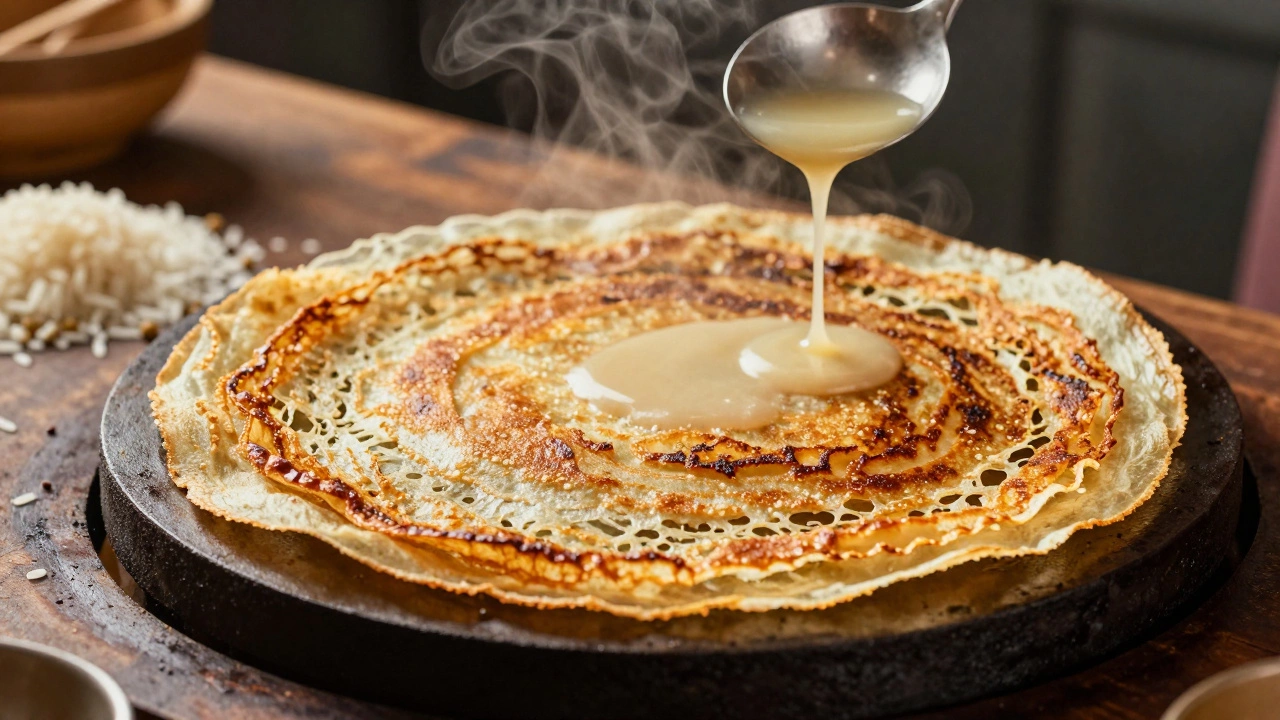
Ever made dosa, poured it onto the hot griddle, and watched it turn out soft, soggy, or rubbery instead of crisp and golden? You’re not alone. Even experienced home cooks in Birmingham, Chennai, or Chicago run into this problem. The truth is, a crispy dosa isn’t luck-it’s science. And if your dosa isn’t crisp, something in your batter recipe or process is off.
Your batter isn’t fermented enough
The number one reason dosa turns out soft? Under-fermented batter. Fermentation isn’t just about bubbles-it’s about flavor, texture, and crispness. The lactic acid bacteria in the batter break down starches into simple sugars. Those sugars caramelize on the hot griddle, giving you that signature crunch.
Most recipes say ferment for 8-12 hours. That’s a guideline, not a rule. In Birmingham’s cool kitchen, where winter temps hover around 8°C, that’s not enough. You need at least 12-16 hours, sometimes up to 20. Look for the batter to double in volume, smell slightly sour like yogurt, and have a light, airy texture. If it hasn’t risen noticeably, don’t even think about making dosa. Wait.
Pro tip: Place your batter in a warm spot. Turn on your oven light, put the bowl inside, and close the door. The gentle heat from the bulb can raise the temperature by 5-7°C-enough to kickstart fermentation. No oven? Wrap the bowl in a thick towel and place it near a radiator.
The rice-to-lentil ratio is wrong
Traditional dosa batter uses parboiled rice (idli rice) and urad dal in a 3:1 ratio. That’s 3 parts rice, 1 part black gram. If you’re using regular white rice or too much dal, you’re setting yourself up for failure.
White rice has less starch than parboiled rice. Parboiled rice is steamed before milling, which locks in more starch and makes the batter hold structure better. When fermented, this starch gelatinizes and forms a crisp outer layer. Regular rice? It turns mushy. Too much urad dal? The batter gets sticky and doesn’t spread thin. You end up with a thick, chewy pancake, not a crispy dosa.
Stick to 3 cups parboiled rice and 1 cup whole urad dal. Soak them separately for 4-6 hours. Grind the dal first into a smooth, fluffy paste. Then add the rice and grind to a slightly grainy texture. Don’t over-grind the rice-it needs texture to help with crispness.
You’re using the wrong water
Tap water can ruin your fermentation. Chlorine and fluoride in treated water kill the good bacteria you need. If you’re in the UK, your water is hard and heavily treated. That’s why your batter might not bubble even after 24 hours.
Use filtered or bottled water for soaking and grinding. Let the water sit out overnight if you must use tap-this lets chlorine evaporate. Some South Indian cooks even use buttermilk or coconut water in small amounts to boost fermentation. It’s not traditional, but it works in colder climates.
The batter is too thick
Thick batter = thick dosa = no crispness. Your batter should be the consistency of thin cream-easily pourable, but not watery. If you have to force it out of the ladle, it’s too thick.
After fermentation, the batter will have expanded. Add water gradually-1/4 cup at a time-until it flows smoothly. Don’t add water before fermentation; it dilutes the culture. Add it after, only as needed. A good test: drizzle a little batter from a spoon. It should leave a trail that slowly disappears.
Too thin? You’ll get holes and tears. Too thick? You’ll get a doughy disc. The sweet spot is when it spreads easily with the back of the ladle and sets within 30 seconds on a hot tawa.
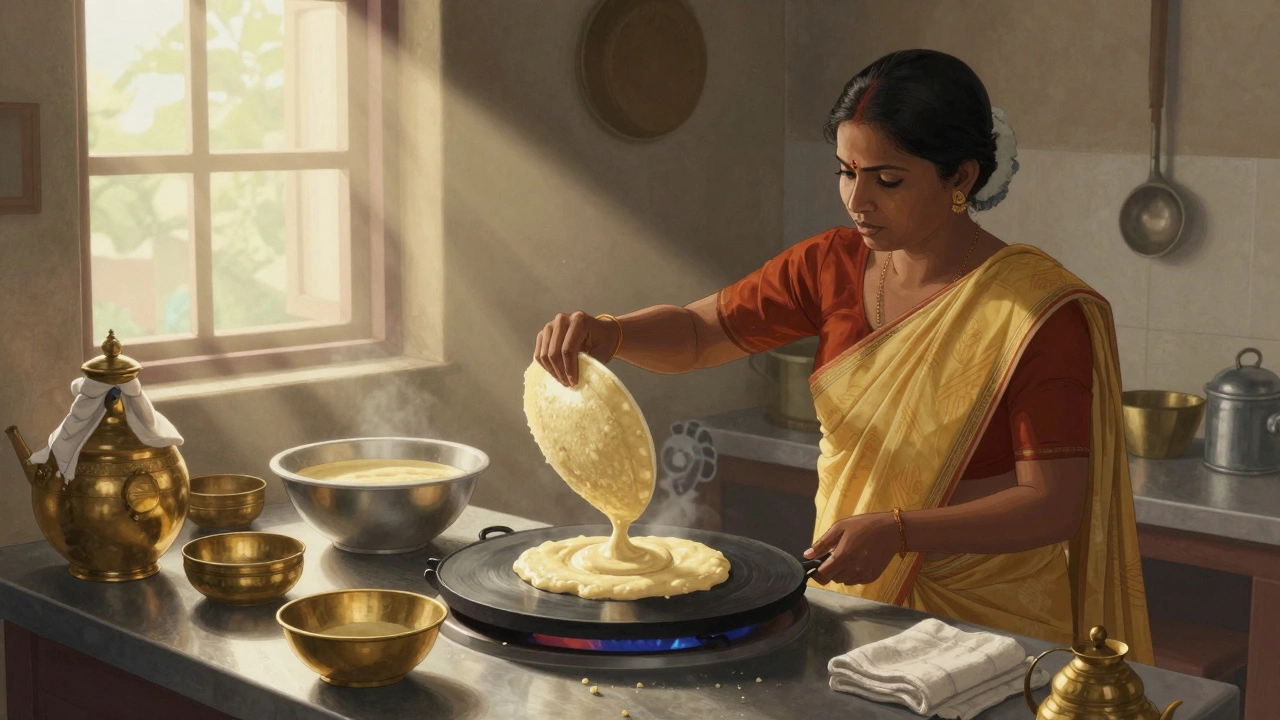
Your tawa isn’t hot enough-or it’s greasy
A cold or greasy griddle is the death of crisp dosa. You need a heavy-bottomed cast iron or carbon steel tawa. Non-stick pans? They won’t get hot enough. You need surface temps of 180-200°C to instantly sear the batter and create that crisp crust.
Preheat the tawa for at least 10 minutes on medium-high. Test it with a drop of water-it should sizzle and evaporate instantly. Then wipe it clean with a damp cloth. No oil needed for the first dosa. Just a light wipe with an oiled paper towel after the first one.
Don’t pour oil onto the batter. That’s a common mistake. Oil on the surface stops the dosa from browning evenly. Instead, drizzle oil around the edges once the dosa starts setting. Let the heat do the work. If you’re using too much oil, you’re frying, not griddling.
You’re spreading it too thick
A crispy dosa is paper-thin. If you’re using the ladle to spread it like a pancake, you’re doing it wrong. Pour the batter in the center, then use the back of the ladle to swirl it outward in a circular motion. Aim for a uniform 1-2 mm thickness.
Thick edges? They stay soft. Thick center? It stays doughy. The thinner the dosa, the faster it crisps. If you’re struggling to spread it thin, your batter might be too thick, or your tawa isn’t hot enough. Practice makes perfect-your first five dosas might be ugly. That’s normal.
Not letting it cook long enough
Don’t flip your dosa too early. Wait until the edges lift naturally and the surface looks dry and matte. That’s when the starch has set and the sugars have caramelized. If you flip it too soon, you’ll tear it and lose the crispness.
Once the top looks set and the bottom is golden brown, turn it over. Cook the other side for just 30-45 seconds. That’s enough to crisp it up without burning. If you cook it too long, it becomes brittle and breaks. Too short, and it’s chewy.
Storage and reheating kill crispness
Leftover dosa? Don’t store it in the fridge in a sealed container. That traps steam and turns crisp into soggy. If you must store it, let it cool completely, then stack with parchment paper in between. Reheat in a dry skillet or toaster oven for 1-2 minutes per side. Microwave? Never. It turns dosa into a rubber sheet.
Best practice: Make dosa fresh. Even if you have leftover batter, use it within 24 hours. After that, the fermentation goes too far-batter turns sour, loses structure, and won’t crisp properly.
Quick checklist for perfect crispy dosa
- Use 3:1 ratio of parboiled rice to urad dal
- Soak rice and dal separately for 4-6 hours
- Grind dal first, then rice-don’t over-grind rice
- Ferment for 12-20 hours in a warm spot
- Use filtered water for soaking and grinding
- Thin batter to cream consistency after fermentation
- Use a heavy cast iron or carbon steel tawa
- Preheat tawa for 10 minutes-hot enough to sizzle water
- Spread thin, swirl with the back of the ladle
- Wait until edges lift before flipping
- Drizzle oil around edges, not on top
- Don’t store dosa in sealed containers
What if you’ve tried everything?
If your dosa still isn’t crisp after fixing all the above, try adding 1/4 teaspoon fenugreek seeds to the urad dal before soaking. Fenugreek boosts fermentation and adds a subtle aroma. It’s a traditional trick used in Tamil Nadu and Karnataka households.
Another option: Add 1 tablespoon of cooked rice or poha (flattened rice) to the batter before grinding. It adds extra starch and helps with crispness. This is common in Andhra-style dosa recipes.
And if you’re still struggling? Don’t blame the recipe. Blame the climate. Fermentation is a living process. It responds to temperature, humidity, and even the bacteria in your kitchen. What works in Chennai might need tweaking in Birmingham. Adjust. Observe. Taste. That’s how you master dosa.
Why does my dosa batter smell bad?
A slightly sour smell is normal during fermentation-it means good bacteria are at work. But if it smells like rotten eggs, vinegar, or ammonia, it’s over-fermented or contaminated. Discard it. Always use clean utensils and containers. If this keeps happening, try refrigerating the batter for 2 hours after grinding before leaving it to ferment-this slows down bad bacteria.
Can I use a blender instead of a grinder?
Yes, but with limits. A high-powered blender works for the urad dal, but it often overheats the batter and makes it too smooth. Over-blending removes texture, which hurts crispness. Grind in short bursts, and let the batter rest between sessions. For rice, a grinder is better-it gives the right grainy texture. If you only have a blender, add ice cubes while grinding to keep the batter cool.
Is it okay to add baking soda to make dosa crisp?
No. Baking soda neutralizes the natural acidity from fermentation, which is what gives dosa its flavor and crisp texture. It may make the batter rise faster, but it kills the sour note and leaves a soapy aftertaste. Real crispness comes from fermentation, not chemicals.
My dosa sticks to the pan. What’s wrong?
Three likely causes: your tawa isn’t hot enough, the batter is too thick, or the pan isn’t seasoned. Cast iron needs to be well-seasoned-think non-stick like a good frying pan. If it’s new or stripped, rub it with oil and heat it on the stove for 10 minutes. Let it cool, then wipe off excess. Do this once a month. Also, don’t pour batter on a cold or wet tawa.
Can I make dosa batter in advance?
Yes, but only up to 2 days in the fridge. Fermented batter lasts longer when chilled. Take it out 2 hours before use and stir well. If it’s been refrigerated, you might need to add a splash of water to bring it back to the right consistency. Never freeze dosa batter-it breaks the bacterial culture and ruins texture.